SUMMARY
Judicial rulings do not merely shape the political and social spheres; they also constitute a structural fiscal risk factor for public finance and macroeconomic balances. In international literature, these risks are defined as ‘contingent liabilities’ and exert direct pressure on the budget through cumulative compensation claims arising from conspiracy cases, files within the scope of Article 141 of the Criminal Procedure Code (CMK), and international disputes before the European Court of Human Rights (ECHR). However, the true financial cost of decisions made in courtrooms reverberates across the broader economy through an increased risk premium, currency pressure, surging interest rates, and the depletion of central bank reserves—all triggered by the resulting legal uncertainty. Given these direct and indirect impacts of judicial decisions, ensuring fiscal discipline requires more than just curbing budgetary expenditures or introducing tax regulations; the state must actively measure and transparently report the inventory of fiscal risks stemming from its own judicial practices.
Court Rulings Do More Than Shape Politics: Risk Born in the Courthouse, Settled in the Treasury
1. Introduction
A country’s judicial system sometimes does more than just dispense justice; it drives up exchange rates and interest rates, and destabilizes the budget. Recent developments in Türkiye confirm precisely this: judicial rulings now determine not only the course of politics but also the unseen vulnerabilities of public finance.
Political tensions have been escalating in a process that began on March 19, 2025, and culminated on May 21, 2026, with the ‘absolute nullity’ decision regarding the Republican People’s Party (CHP). But the real question is: is the price of these decisions paid solely in the political arena? No. A portion of it manifests directly as compensation payments, while a much larger share ripples through the budget and the wider economy via currency depreciation, high interest rates, inflation, and a loss of confidence. Consequently, experts monitoring economic data have now begun to keep a close eye on courtroom developments as well
2. Why Do Legal Decisions Pose Fiscal Risks?
In public finance literature, legal disputes are categorized among the classic sources of “fiscal risk.”
Fiscal risks are defined as hard-to-predict, often downward, and transmissible shocks across institutions that cause deviations from budget forecasts.
Studies by the World Bank and the IMF (International Monetary Fund) on public debt and fiscal risk management also demonstrate with historical data that legal claims ruled against governments constitute one of the largest sources of fiscal risk.
This picture fits the situation in Türkiye perfectly. Indeed, court rulings sometimes generate high compensation in a single file, and at other times, they create a cumulative burden by triggering hundreds of similar lawsuits through the same legal logic. Therefore, the issue goes far beyond a mere matter of “a lawsuit was lost” and brings to the fore the question of how much of a financial burden public finance faces due to judicial decisions.
3. What Does the IMF Standard Say?
The International Monetary Fund’s (IMF) Fiscal Transparency Handbook defines public obligations that arise depending on specific events as “contingent liabilities.”
Legal obligations stemming from judicial claims, lawsuits, and other disputes also fall under the scope of contingent liabilities. This is because a fiscal obligation emerges in the event that these lawsuits are concluded against the public sector.
According to this IMF approach, which serves as a basis for international practices, the expected fiscal burdens resulting from judicial decisions must be visible in budget documents, fiscal risk statements, and within-year reporting.
However, there is no regular, systematic, and publicly available reporting in this area in Türkiye. In this context, information regarding the magnitude and probability of occurrence of these legal risks remains in the dark. In summary, fiscal risks that may arise from court rulings are not a secondary legal matter to be dealt with on an “if it happens, we’ll see” basis.
4. The Large Risk Pool Within: Conspiracy Cases
One of the largest cumulative compensation risks arising against the Treasury in Türkiye stemmed from the major criminal files publicly referred to as “conspiracy cases.” This is because, rather than isolated individual errors, we are speaking of a collective legal phenomenon where hundreds of people were prosecuted for years, a significant majority of whom were acquitted, subsequently giving rise to compensation claims against the state.
Instead of explaining this section at great length, looking at data compiled from open sources makes it easier to understand the general framework:
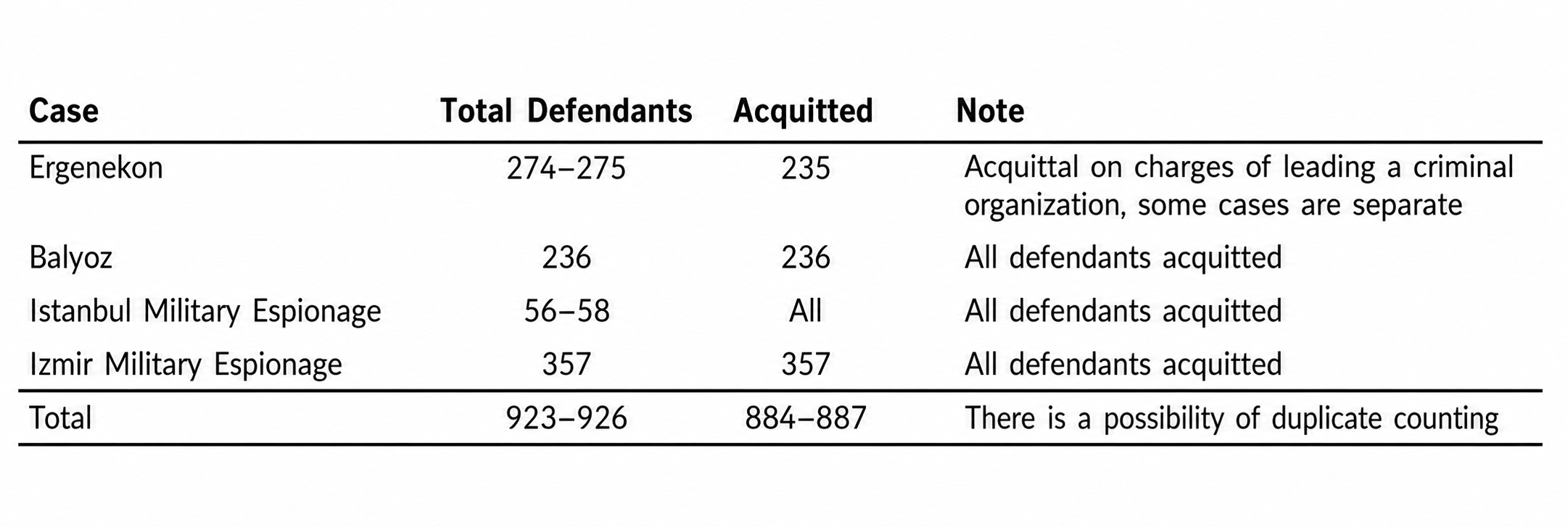
Source: Compiled from media and other open sources. Indicative only.
This table is certainly not fully comprehensive; indeed, other files such as Poyrazköy, the Assassination Plot against Admirals, and similar cases are not included. However, it provides an idea regarding the magnitude of risks related to judicial decisions. Within this scope, nearly all of the more than 900 people prosecuted in these conspiracy cases were acquitted. This situation automatically translates into hundreds of potential compensation files. Examples reflected in the media show compensation figures ranging from hundreds of thousands to millions of Liras. Even under conditions where a compensation lawsuit might not have been filed for every single acquittal and where files contain varying payment magnitudes, it is understood that there is a total risk amounting to billions of Liras.
Beyond the numerical volume, the fundamental problem is the complete lack of available data regarding the total cost of this burden.
5. CMK Article 141 and Administrative Lawsuits
Conspiracy cases stand out because they are high-profile; however, the fiscal risk is not limited to these files alone. Compensation lawsuits filed under CMK Articles 141–144 (Criminal Procedure Code) due to unjust arrest and protective measures accumulate a new burden every year. Open-source examples and current jurisprudence evaluations shared within legal circles demonstrate that even for a few months of detention, non-pecuniary damages amounting to hundreds of thousands of Liras can be involved, and in some instances, this exceeds 1 million TL.
Another area consists of full remedy actions (actions for damages). Lawsuits concerning expropriation, de facto expropriation without expropriation decrees, land registry errors, public service faults, or death and injury during military service also exert regular pressure on the Treasury over time. Disputes arising between the administration and contractors in infrastructure projects and procurement can similarly burden the budget in the form of interest and compensation.
6. The International Front: ECHR, ICSID, and Commercial Disputes
Just as critical as domestic legal risks are the magnitude and nature of international legal disputes to which Türkiye is a party, especially regarding fiscal risks. This is because this domain does not merely impose a burden on the budget; it also affects the country’s risk perception and investor behavior.
According to the end-of-2024 statistics of the European Court of Human Rights (ECHR), there are approximately 21,600 pending applications originating from Türkiye, which corresponds to 35.8% of the Court’s total pending workload. Although the number of new applications declined to 18,464 in 2025, Türkiye still stands out as the country generating the highest number of applications.
The most striking file on the ECHR front is the Cyprus v. Türkiye case. In 2014, the Court ruled that Türkiye must pay 90 million euros in compensation. This ruling is recognized as one of the largest compensation decisions in ECHR history. When landmark cases such as Loizidou are added, Cyprus-related files have entailed not only legal but also fiscal and diplomatic consequences for Türkiye.
In individual applications, the trajectory of cases like Osman Kavala, Selahattin Demirtaş, and Yüksel Yalçınkaya points to systemic trial issues in addition to singular violations in Türkiye. Some of these cases may not involve high compensation awards; however, their impact in undermining the country’s risk perception can be greater than their direct monetary burdens.
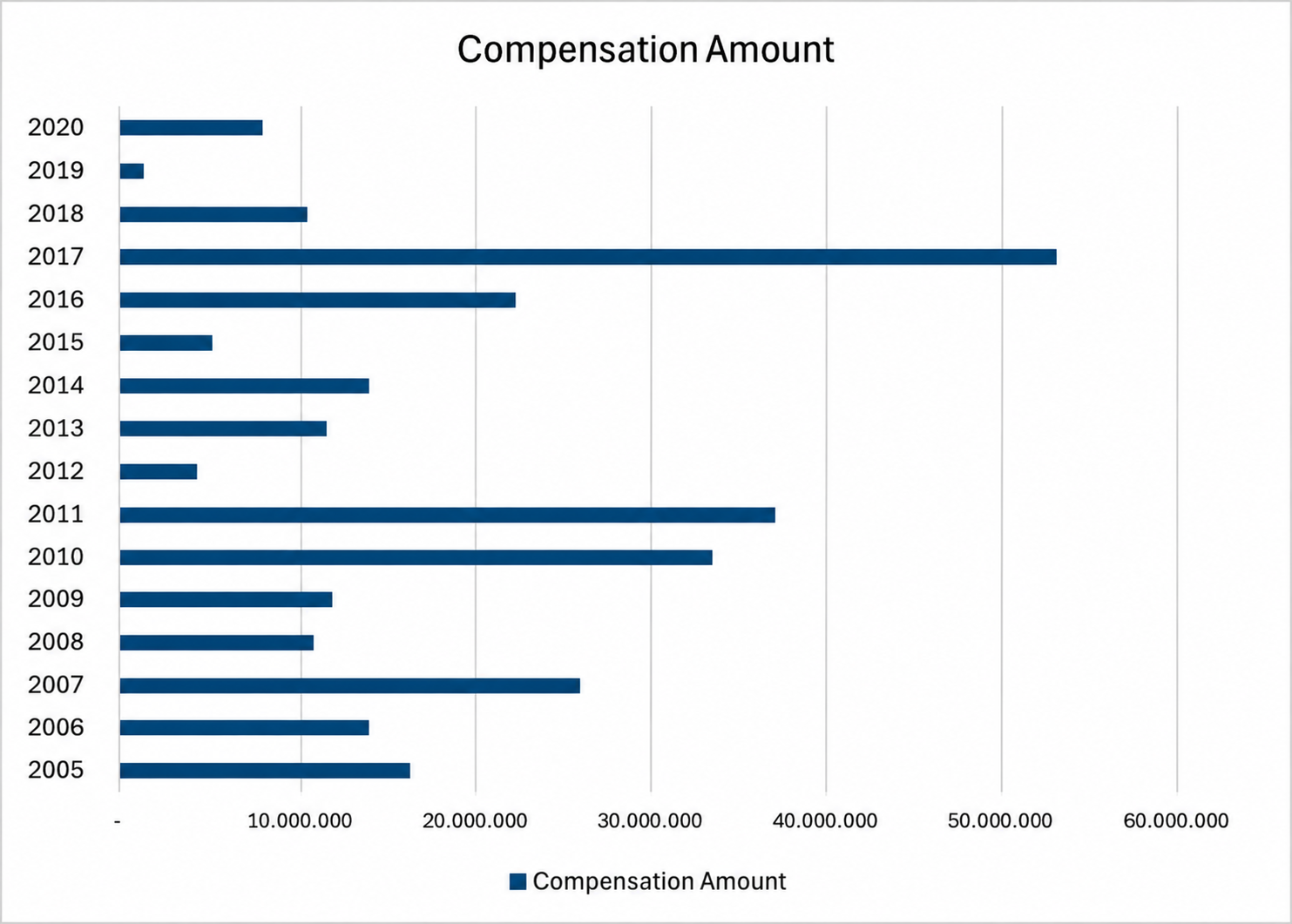
Source: verikaynagi.com
In the field of investment arbitration, Türkiye is most frequently on the respondent side. Disputes in energy, construction, and privatization stand out. Publicly available data suggests that Türkiye has not faced major compensation liabilities in many of these files. Yet, in international arbitration, what matters is not the number of lawsuits lost or the smallness/largeness of the amount paid. It is far more critical whether Türkiye is perceived as a state governed by the rule of law, and whether investors price Türkiye as a “jurisdiction with a high risk of legal dispute.”
7. The Invisible Bill: Exchange Rates, Interest Rates, and Growth
What has been described up to this point is the direct impact of legal risk on the budget. However, the story does not end here. This is because the cost of court rulings is not limited solely to the compensation checks written by the Treasury. When legal uncertainty increases, and when judicial processes overtake politics and economic management, the largest share of the bill is often settled in the markets.
With the impact of judicial decisions, uncertainty increases, investor confidence weakens, the risk premium rises, and exchange rate pressure intensifies alongside the capital flight from the Turkish Lira. When the exchange rate rises, inflation increases through the pass-through effect, or the decline of inflation becomes harder to achieve. As long as inflation does not fall, interest rates continue to remain high. As interest rates stay high, the Treasury’s borrowing costs increase, and the business world and individuals are exposed to higher loan interest rates: the economy slows down.
Consequently, a cost much larger than the direct financial compensation burden generated by court rulings is inflicted upon the budget via interest expenditures, and upon the economy as a whole.
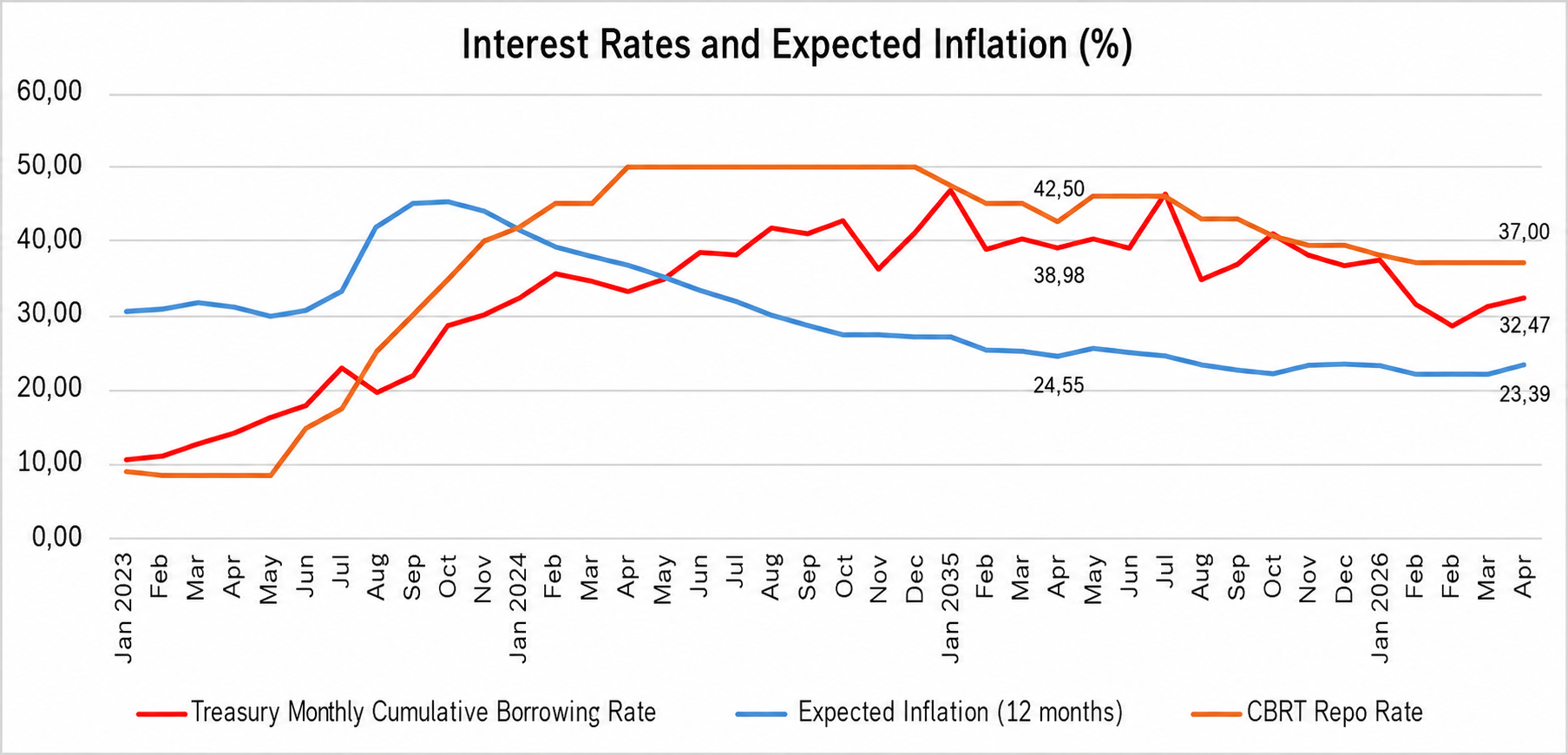
Source: Generated from CBRT and MTF data.
How judicial decisions affect the economy has become evident starting from the first quarter of 2025. In this context, inflation expectations, which had been on a downward trend, began to follow a flat course after March 2025 due to the combined impact of domestic judicial decisions and international developments. During this period, while the Central Bank was on a path to cut the policy rate, it resorted to a rate hike instead, and the Treasury’s borrowing costs also showed an increase.
In summary, the impact of judicial decisions is not limited merely to compensation; it reflects upon the interest bill, borrowing conditions, and economic confidence. Therefore, legal risks are priced not in the courtroom, but in the Treasury auction.
On the other hand, it is also necessary to note the experts’ assessments indicating a depletion of reserves in the CBRT (Central Bank of the Republic of Türkiye) at the level of 50 billion dollars after March 19, 2025, and at the level of 8–10 billion dollars after May 21, 2026.
8. Conclusion: What Needs to Be Done?
First, as a first step, the Ministry of Treasury and Finance, together with the Ministry of Justice and relevant institutions, must establish a centralized fiscal risk inventory for legal matters. Major compensation lawsuits filed within domestic law, and files under CMK (Criminal Procedure Code) Article 141, as well as ECHR (European Court of Human Rights) applications, ICSID (International Centre for Settlement of Investment Disputes), and other arbitration processes should be monitored in an aggregated manner.
The second step is the public disclosure of this data within a fiscal risk report to be appended to the annual budget.
The third step is the regular reporting of payments made under the scope of this risk. Consequently, citizens can obtain information regarding how much has been paid with their taxes, within the scope of which domestic and international files, which fields of dispute stand out, and other similar details.
Any discussion on “fiscal discipline” will remain incomplete without soundly identifying and valuing fiscal risks. This is because fiscal discipline is not merely about curbing expenditures or increasing taxes; the state’s recognition, measurement, and public reporting of the risks arising from its own legal order is also a part of this process. Indeed, this story that begins in the courthouse ends up, sooner or later, in the Treasury’s coffers—meaning, in the pocket of the citizen.