Home Blog Page 6

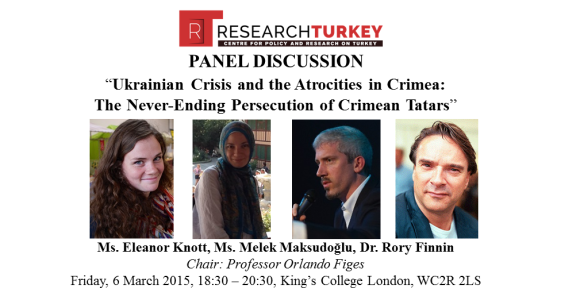
Public Conference: “Ukrainian Crisis and the Atrocities in Crimea: The Never-Ending Persecution of Crimean Tatars”, 6 March 2015, King’s College London

0

Title: “Ukrainian Crisis and the Atrocities in Crimea: The Never-Ending Persecution of Crimean Tatars”
Speakers: Dr. Rory Finnin (University of Cambridge), Ms. Eleanor Knott (London School of Economics and Political Science (LSE)), Ms. Melek Maksudoğlu (King’s College London (KCL))
Titles of the Talks:
Dr. Rory Finnin: “The Crimean Tatars: One Year after the Russian Annexation”
Ms. Eleanor Knott: “Why is there Antagonism between Russian Nationalists and Crimean Tatars?”
Ms. Melek Maksudoğlu: “Never Ending Struggles of the Crimean Tatars: Return and Stay in Homeland”
Chair: Professor Orlando Figes, Professor of History, Birkbeck College, University of London
Date: Friday, 6 March 2015
Time: 6:30pm – 8:30pm
Venue: S-1.06, Lecture Theatre, Strand Campus, King’s College London, WC2R 2LS

We are pleased to announce Centre for Policy and Research on Turkey (Research Turkey)’s public conference entitled “Ukrainian Crisis and the Atrocities in Crimea: The Never-Ending Persecution of Crimean Tatars” in which Dr. Rory Finnin, Ms. Eleanor Knott and Ms. Melek Maksudoğlu will give talks. This event will take place on Friday, 6 March 2015 between 6:30p.m. and 8:30p.m. at S-1.06, Lecture Theatre, Strand Campus, King’s College London, WC2R 2LS. Professor Orlando Figes, Professor of History, Birkbeck College, University of London will kindly chair the event.

Important Note: The conference will follow documentary screening of “Son of Crimea (Kırımoğlu): Struggle of a People”. The screening will include a one-hour section of the documentary and will take place between 5:00p.m. and 6:00p.m. in the same venue. You may click here for more information about the documentary screening.

P.S. Centre for Policy and Research Turkey (Research Turkey) hereby expresses its special thanks to the director, Neşe Sarısoy Karatay and the producer, Zafer Karatay of the documentary “Son of Crimea (Kırımoğlu): Struggle of a People” for providing the copy and permission for screening of it publicly.

You may find the short biographies of the speakers and the chair as well as their talks’ abstracts below.

Both events are free and open to public but it require pre-registration. A ticket does not guarantee a seat. Please click here for free registration and tickets.

Short Biographies of Panelists, the Chair and Abstracts of the Talks

Panelist: Dr. Rory Finnin, Senior Lecturer, Head of Department of Slavonic Studies, and Director of Ukrainian Studies Programme, University of Cambridge
Title: “The Crimean Tatars: One Year after the Russian Annexation”

Dr. Rory Finnin is Senior Lecturer in Ukrainian Studies, and Head of Department of Slavonic Studies at the University of Cambridge. Dr. Finnin also directs the Cambridge Ukrainian Studies Programme at Cambridge and chairs the Cambridge Committee for Russian and East European Studies. He received his PhD (with distinction) in Slavic Languages and Comparative Literature from Columbia University. His primary research interest is the interplay of literature and national identity in Ukraine. He also studies Soviet Russian dissident literature and Turkish nationalist literature. His broader interests include nationalism theory, human rights discourse, and problems of cultural memory. His current project is a comparative study of the role of lyric poetry in the emergence of modern European nationalisms. Dr. Finnin has published extensively in his research areas. His recent publication is “Captive Turks: Crimean Tatars in Pan-Turkist Literature” Middle Eastern Studies 50.2 (Spring 2014).

Panelist: Ms. Eleanor Knott, PhD Candidate, Department of Government, London School of Economics and Political Science (LSE)
Title: “Why is there Antagonism between Russian Nationalists and Crimean Tatars?”
Abstract: While Crimean Tatars, who have been returning to the Crimean peninsula since the late Soviet period, faced discrimination in post-Soviet Ukraine, this is incomparable to the crackdown imposed on Crimean Tatars since Crimea’s annexation in February 2014. In her talk, Ms. Knott will first examine both historical and contemporary discrimination, to examine how Crimean Tatars are being punished for supposed “political extremism” by the new post-annexation authorities. Second, she will try to analyse why Crimean Tatars have been targeted. In particular, she will examine the sentiments of local Russian nationalist groups who were instrumental in Crimea’s annexation in 2014. Ms. Knott will argue that given the groups and individuals now in power, and their pre-existing antipathy to the Crimean Tatars, we should remain concerned about the future of Crimean Tatars in the peninsula.

Eleanor Knott is a PhD candidate in the Department of Government at the London School of Economics. Her thesis analyses Romanian kin-state policies in Moldova and Russian kin-state policies in Crimea and is based on fieldwork she conducted in Crimea and Moldova in 2012 and 2013. Ms. Knott publishes in her research areas such as Ukrainian politics and Crimean Tatars. Her recent publication (co-authored with Liana Fix) is “In Crimea, Time for Pressure, not Acceptance: Why We cannot Lose Sight of the Crimean Tatars,” a report published by German Council on Foreign Relations (DGAP) in December, 2014.

Panelist: Ms. Melek Maksudoğlu, PhD Candidate, King’s College London (KCL)
Title: “Never Ending Struggles of the Crimean Tatars: Return and Stay in Homeland”
Abstract: The struggle started when the Crimean Tatars were deported in May, 1944 to Siberia and to Central Asia. They organised themselves as National Movement (Milli Mücadele, in Turkish) under the leadership of Mustafa Djemilev, and used peaceful strategies to return to the homeland. İn this talk, Ms. Maksudoğlu will first give a historical background of the Crimean Tatars, their struggle under the Soviet regime, and how they overcame, and managed to return to the homeland. Second, she will examine what strategies this minority group in their homeland are using, and what they are expecting from Turkey, as the largest Crimean Tatar descents live in Turkey. Third, she will analyse the significance of the President Putin’s visit to Turkey to the Crimean Tatars, and what would happen in the near future.

Melek Maksudoğlu graduated from the International Islamic University, Malaysia in 1999. She completed her MA dissertation on the Crimean Tartars’ struggle to return through SOAS (School of Oriental and African Studies) in 2004. Currently she is completing her PhD at King’s College, London. Her current research focuses on Crimean Tartar national identity, with a particular interest in how that identity has been maintained and transformed, during the period of deportation and resettlement (1944 through to 1967). Ms. Maksudoğlu presented her early research findings at the 2nd International Conference of Turkology in Simferopol, Crimea in 2008. Following this she worked, in a voluntary capacity, translating Ottoman archival documents for Orlando Figes’ “Crimea, The Last Crusade” (2010, Penguin: London). In the same year, she presented a paper at the 2nd International Scientific Reunion entitled “The Historical Heritage of Tatars.” Constanta, Rumania and in 2011 her article “Keeping the National Identity; The Crimean Tatars” was published in the Historical Journal of Turkey, Tarih Bilinci, İstanbul in 2011. In the same year her interview of Cengiz Dağcı was published in Turkey’s Language and Literature Journal (2011:  Dil ve Edebiyat, İstanbul). In 2012 Ms. Maksudoğlu worked with a visual artist at the Yunus Emre Cultural Centre, London, on an exhibition entitled ‘Deported Faces’. This exhibition commemorated the beginning of the deportations which started on May 18th in 1944. Since 2012 events in Crimea have developed rapidly: Ms Maksudoğlu’s interest and expertise in this region has resulted in her being called upon to give her expert opinion by Aljazeera, as well as national broadcasters in England and Turkey.

Chair: Professor Orlando Figes, Professor of History, Birkbeck College, University of London

Orlando Figes is a prominent British historian and writer best known for his works on Russian history. He is Professor of History at Birkbeck College, University of London. Professor Figes is known for his works on Russian history, in particular A People’s Tragedy (1996), Natasha’s Dance (2002), The Whisperers (2007), Crimea (2010) and Just Send Me Word (2012). A People’s Tragedy is a study of the Russian Revolution, and combines social and political history with biographical details in a historical narrative. In 2008, the Times Literary Supplement named A People’s Tragedy as one of the ‘hundred most influential books since the war’. It was awarded the Wolfson History Prize, the WH Smith Literary Award, the NCR Book Award, the Longman-History Today Book Prize, and the Los Angeles Times Book Prize. Natasha’s Dance and The Whisperers were both short-listed for the Samuel Johnson Prize, making Figes the only writer to have been short-listed twice for this prize. The Whisperers was also short-listed for the Ondaatje Prize, the Prix Médicis, and the Premio Roma. Professr Figes also serves on the editorial board of the journal Russian History, writes for the international press, broadcasts on television and radio, reviews for the New York Review of Books, and is a Fellow of the Royal Society of Literature.
Conference: “THE LOST AND THE NEW WORLDS OF WELFARE”

0

Conference: “THE LOST AND THE NEW WORLDS OF WELFARE” which requires a submission of paper in Stream 1 “The role of policy entrepreneurs, advisers and experts in the diffusion of social policy”

Organizers: CfP Stream 1, Elke Heins, University of Edinburgh ([email protected]) and Hartwig Pautz, University of the West of Scotland ([email protected]).

Venue and Date: University of Southern Denmark 3-5 September

Abstracts should be sent to [email protected] by the 10th of March 2015.

For detailed information you can click here to go to the related website :
Description of Stream 1:

Important changes have taken place in the last two decades in European welfare states regarding the main types of social policy actors. In the ‘old’ world of welfare, key actors used to mainly comprise government executives and bureaucrats, political parties as well as trade unions and employer organisations, the latter often enjoying official consultation status through institutionalised corporatism. In the ‘new’ welfare state, an increasingly fragmented and competitive mixed economy of policy advice involving think tanks, lobbying groups, advocacy organisations, unelected special policy advisers and international bodies providing expertise to governments in addition to the old stakeholders are found. This shift has partly been fuelled since the 1990s by a trend towards a seemingly pragmatist and evidenced-based ‘What Works?’ approach to policy making replacing allegedly more partisan political and ideological approaches of earlier decades. As a result, various think tanks, international experts, scientific advisers and other new ‘policy entrepreneurs’ gained significant influence on the policy process and the spreading of ideas.

This stream proposal suggests analysing the role of such new ‘knowledge breakers’ in the production of social policy responses in the ‘Age of Austerity’ and, importantly, their role in the diffusion of these policy responses within and across welfare states. Envisaged papers for this stream to engage, inter alia, with some of the following questions:

What insights do we have into the role of the various new policy actors for policy-making and diffusion of ideas in ‘hard times’?

What are the strengths and weaknesses of existing policy advice landscapes in different welfare states with respect to policy production and diffusion?

What are the politics of ‘knowledge’ diffusion?

Who produces ‘knowledge’ and who produces ‘ignorance’ (through concealing evidence or spreading of misinformation, e.g. of the effects of the suggested solutions or the availability of alternatives)?

Which strategies are employed to influence social policies and in what direction is policy change being influenced?

What impact does the different influence of some of these new actors have on welfare policy design?

Contributions engaging with such questions are invited in relation to social policy reforms throughout Europe in recent decades, particularly since the 2008 Financial Crisis, Great Recession and related Euro Crisis. While the fiscal response to the crisis in the 1970s primarily involved increases in government spending, in the current crises governments have relied predominantly on tax cuts to stimulate the economy and on spending cuts to achieve fiscal consolidation while also arguing for structural reform. The patterns of response thus follow recent paths of welfare state change, including a turn towards ‘activation’ through toughening access to unemployment and other benefits, as well as curtailing public expenditure in the areas of health care, pensions and education. It is thus an intriguing and important question what role any new groups producing policy advice played in creating this hegemonic discourse and how other ideas have been marginalised.

The stream invites paper proposals that address these issues with various methodological approaches.  Studies are welcomed from specific social policy areas as well as broader welfare state analyses.

Interview with Associate Professor Samer Shehata: Recent Political Dynamics in the Middle East

0
Interview with Associate Professor Samer Shehata: Recent Political Dynamics in the Middle East Since the beginning of Syrian civil war, the dynamics of the Middle East have significantly changed and are still in a transformation process. On one hand, scholars and policymakers have been analyzing the underpinning reasons behind the emergence of the Islamic State of Syria and Iraq (ISIS). On the other hand, they have been assessing the post-Arab uprisings period in Egypt, Tunisia and Libya. In this context, Turkey and its politics have influenced or at least have attempted to influence the changing atmosphere of the Middle East, […]
To access this post, you must purchase Annual Membership.

Public Conference: “The Forgotten Victims in the Middle East: Plight of Iraqi Turkmens”, 2 March 2015, SOAS

0

Title: “The Forgotten Victims in the Middle East: Plight of Iraqi Turkmens”
Speaker: Ms. Sundus Abbas, The Representative of the Iraqi Turkmen Front in the UK
Chair: David Alton, Member of the House of Lords, and Professor of Citizenship, Liverpool John Moores University
Date: Monday, 2 March 2015
Time: 7:00pm – 8:30pm
Venue: Brunei Gallery, Room B104, SOAS, University of London, WC1H 0XG
Click here for free tickets and registration.

We are pleased to announce Centre for Policy and Research on Turkey (Research Turkey)’s public conference entitled “The Forgotten Victims in the Middle East: Plight of Iraqi Turkmens” in which Ms. Sundus Abbas, The Representative of the Iraqi Turkmen Front in the UK  will give a talk. This event will take place on Monday, 2 March 2015 between 7:00p.m. and 8:30p.m. at Brunei Gallery, Room B104, SOAS, University of London, WC1H 0XG. David Alton, Member of the House of Lords, and Professor of Citizenship, Liverpool John Moores University will kindly chair the event. The event is co-sponsored by SOAS Development Studies, Neoliberalism, Globalisation and States Research Cluster.

You may find the abstract of the talk and short biographies of Ms. Sundus Abbas and the chair David Alton below.

This event is free and open to public but it is a ticketed event that requires pre-registration. A ticket does not guarantee a seat. Please click here for free registration and tickets.

Abstract of the Talk

The Iraqi Turkmen have been victims of decades of persecution and victimisation as a distinct community in Iraq. Hopes that the overthrow of Saddam Hussein would improve their situation and offer redress for past injustices suffered have yet to be fulfilled as they continue to suffer from various forms of discrimination and assimilation and migration pressures. After ISIL’s attack, ISIL started to attack Turkmen town and villages starting from Telafer, Basheer , Taza, Birowchli, Amirli and others, driving more than 300 thousands Turkmens from their homelands, killing hundreds and kidnapping others including women and children. ISIL fighters are currently en route to Kirkuk, which is another city inhabited by Turkmens. Kirkuk has been exposed to a Kurdization process since the 2003 American invasion after the long years of Saddam’s suppressive Arabization policies. This event will highlight some of the most pressing issues currently facing Turkmen in Iraq and offer an opportunity to discuss ways forward to improve their situation.

Short Biography of Ms. Sundus Abbas

Sundus Abbas is Representative of the Iraqi Turkmen Front in the UK. She was born in Kirkuk, Iraq. She graduated as a civil engineer from Al Salahuddin University in 1986 and then graduated from Greenwich University with a higher diploma in computer science in 1999. She moved to Britain after the Second Gulf War, when the old regime targeted Kirkuk and surrounding areas, and has been working as a political activist since 1991 to define the Iraqi Turkmen cause in Britain and Europe. Since 2009, she has been appointed as the representative of the Iraqi Turkmen Front. Represented Iraqi Turkmens in many conferences held in Britain, the United Nations and Europe.

Short Biography of David Alton

David Alton (The Rt. Hon Prof. the Lord Alton of Liverpool) is Professor of Citizenship at Liverpool John Moores University and is a Visiting Fellow at the University of St.Andrews. Having been elected as the UK’s youngest City Councillor while still a student in 1972, David became Deputy Leader and Housing Chairman of Liverpool Council. He also worked as a teacher for seven years before becoming a Member of Parliament. After 8 years as a City Councillor, he served as a member of the British House of Commons for 18 years, where he was Liberal Chief Whip. In 1997, he was appointed to the House of Lords, and for the past 18 years, he has been a Member of the House of Lords, where he has sat as an Independent Crossbench Peer. David Alton is one of Britain’s longest serving and most senior parliamentarians.  In Parliament, he is Chairman of the All Party Group (APG) on North Korea  and Chairman of the  Human Dignity APG; Vice Chairman – Foreign Affairs APG; Tibet APG; Religious Freedom APG; Armenia APG; and an officer of the  Sudan APG and Cafod APG. Outside of Parliament, with Danny Smith, he launched the human rights group, Jubilee Campaign, which led to campaigns, visits and reports on the plight of Jewish and Christian dissidents in the former Soviet Union and Eastern Europe. Throughout the 1990s, and subsequently, he has continued his campaigns for human rights and the sanctity of human life. He is a trustee, patron or president of a number of charities and voluntary organisations, is a Foundation Governor of the Liverpool Bluecoat School and is a Governor of Stonyhurst College. Among the international awards he has received are the Michael Bell Memorial Award for Initiatives for Life, The Mystery of Life Award, and the Advocates International Award for human rights work. His eleven books include “Citizen Virtues” and “Pilgrim Ways”.

Call for Applications for Mercator-IPC Fellowships

0

Stiftung Mercator and Istanbul Policy Center at Sabancı University invite academics, journalists and professionals with an interest in Turkey to apply for a fellowship program that aims to strengthen academic, political and social ties between Turkey and Germany, as well as Turkey and Europe. The program is based on the premise that the acquisition of knowledge and the exchange of people and ideas are preconditions for meeting the challenges of an increasingly globalized world in the 21st century.

Mercator-IPC Fellows work at Istanbul Policy Center (IPC), an independent policy research institute with global outreach located in the center of Istanbul. IPC’s mission is to foster academic research and its application to policy making. The Center is firmly committed to providing decision makers, opinion leaders, academics and the general public with innovative and objective analyses of key domestic and foreign policy issues.

IPC offers Mercator-IPC Fellows access to a broad network of academics, civil society activists and decision makers as well as a unique platform for sound academic research to shape hands-on policy work. Likewise, fellows profit from Sabancı University’s exceptional intellectual capital and vast reserves of scientific knowledge.

Mercator-IPC Fellowships are available to outstanding academics, journalists and professionals who work in one of three thematic areas:

EU/German-Turkish relations
Climate change
Education

In the 2015/16 round, at least six Mercator-IPC Fellowships are available for outstanding young academics as well as journalists and professionals who have significant prior work experience. The fellows will be expected to work on academic or practical projects at IPC. A Master’s degree (or equivalent) is required for this position, but a PhD degree is strongly preferred. Applicants without a PhD degree will only be accepted if their work experience and expertise meet the program requirements to the jury’s satisfaction. Projects which focus on the German-Turkish nexus are likewise preferred. Applicants cannot apply for fellowships to fund their PhD dissertations.

The 2015/16 fellowships begin September 1, 2015 and the deadline for applications is April 6, 2015.

You may send applications or any questions by email to Research Associate Ms. Cigdem Tongal (see below for contact details). For full details, see the Mercator-IPC Fellowship Program guidelines at: http://ipc.sabanciuniv.edu/en/about_fellowship/.

For further questions you may contact:

Çiğdem Tongal, Mercator-IPC Fellowship Research Associate
Email: [email protected]
Tel.: 90 (0) 212 292 49 39 ext. 1418

or

Gülcihan Çiğdem Okan, Research and Administrative Affairs Assistant
Email: [email protected]
Tel:  90 (0) 212 292 49 39 ext. 1417

Research Turkey Panel Discussion: “Turkey’s EU Accession Process: What have We Learnt from Europeanization Research?”

0

Speakers: Dr. George Kyris, Dr. Diğdem Soyaltın, Dr. Didem Buhari-Gülmez and Dr. Seçkin Barış Gülmez
Title: Turkey’s EU Accession Process: What have We Learnt from Europeanization Research?
Location: K2.31, 2nd Floor, King’s College London, Strand Campus, King’s College London, WC2R 2LS
Date: Friday, 6 February 2015, 6:30 p.m. – 8:30 p.m.
Chair: Gamon McLellan, Senior Lecturer, SOAS, University of London, and Former BBC World Service Journalist and Analyst

We are pleased to announce Centre for Policy and Research on Turkey (Research Turkey)’s panel discussion entitled “Turkey’s EU Accession Process: What have We Learnt from Europeanization Research?” in which Dr. Diğdem Soyaltın, Dr. George Kyris, Dr. Didem Buhari-Gülmez and Dr. S. Barış Gülmez will give talks. This event will take place on Friday, 6 February 2015 between 6:30 p.m. and 8:30 p.m. at  K2.31, 2nd Floor, King’s College London, Strand Campus, King’s College London, WC2R 2LS. Gamon McLellan, Senior Lecturer, SOAS, University of London will kindly chair the event.

Please find below the abstracts of the talks along with short biographies of our speakers and the chair. This event is free and open to public but it is a ticketed event that requires pre-registration. A ticket does not guarantee a seat. Please register and reserve a ticket via the address below:

rt-eu-panel-kingscollege-feb15.eventbrite.co.uk

Abstracts of the Talks

Panelist: Dr. Diğdem Soyaltın, Post-doc fellow, Stockholm University

Public Sector Reforms to Fight Corruption in Turkey: Why Is Not a Failure Case of Europeanisation?

A massive public corruption scandal came to light in December 2013 in Turkey. A number of high-ranking politicians, business leaders and sons of political ministers were arrested and accused of bribery and profiting from illegal construction projects. This doesn’t come a surprise to scholars who already identified the anti-corruption policy as a failure case of Europeanization and more generally of external governance promotion since externally induced formal changes remained to a large extent decoupled from behavioural practices and hardly resulted in better governance. This paper will show that external anti-corruption efforts can promote institutional change and help countries to close the gap between formal changes and behavioural practices when several patterns of domestic conditions are present. The overall argument is illustrated by comparing varying levels of institutional change in the public sector of Turkey with regard to the civil administrative system, public finance management system and public procurement system.

Panelist: Dr. George Kyris, Lecturer in International and European Politics, University of Birmingham

The Europeanisation of Turkey’s Foreign Policy and the Cyprus issue

Drawing on debates on Europeanisation and empirical material such as interviews with EU and local elites, this work examines how the prospects of EU accession have influenced Turkey’s policy towards the Cyprus dispute after 2004. The argument advanced is that, although initially Turkey’s EU aspirations led to a flexible position of Ankara, the ability of the EU to trigger a constructive stance of Turkey vis a vis the dispute has been gradually weakened. This is mostly because of new developments, not least the 2004 EU accession of Cyprus as a divided island or Greek Cypriot efforts for gas exploration in the Mediterranean, that have led to more inflexible Turkish positions towards the Cyprus dispute. In this context, providing clear(er) accession prospects is the ‘gordian knot’ that the EU will have to address in order to influence the country’s foreign policy towards more flexible position on the dispute.

Panelist: Dr. Didem Buhari-Gülmez, LSEE Visiting Fellow and Dr. S. Barış Gülmez, Teaching Fellow, Warwick University
“Praying for Europe: The Turkish Mosque as a Space of Europeanization”

This work-in-progress paper suggests that the Turkish Mosque is more than a place of worship that is exclusively situated in the private (outside the public) and religious (outside the political) spheres. Instead, the Mosque is a space that is constitutive of identity, attitudes and interests because it involves not only education and social engineering, but also political struggles, and nation-building. There is need to correct two misleading tendencies about the place and the role of the Turkish Mosque in Turkey’s Europeanization process: (1) that the Mosque is against the idea of Europe and hinders Europeanization, and (2) that the Mosque is immune to the effects of Europeanization and globalization. A shift of emphasis from ‘sender-receiver Europeanization’ to ‘ritualized Europeanization’ allows to rethink the binary logic and the imagined boundaries between religious and political, private and public, or Islamic and European. The Turkish case highlights the complex and dialectical nature of the interactions between Islam and Europeanization in Turkey, which involves both contestation and co-constitution.

Short Biographies of the Chair and Speakers

Dr. Diğdem Soyaltın: Diğdem Soyaltın (Ph.D., Freie Universitaet Berlin) is a postdoctoral fellow at Institute of Turkish Studies at Stockholm University. In her doctoral dissertation she worked on the role of international anti-corruption regimes including the EU, on implementation of public sector reforms to fight against corruption in Turkey. Her research articles appeared in Journal of Balkan and Near Eastern Studies and Turkish Studies. Soyaltin’s also has a co-authored forthcoming book chapter on comparing Europeanization processes in Turkey and Central and Eastern European countries and has co-authored a book chapter on the limits of Europeanization in explaining domestic change in Turkey. During her doctoral studies she worked a research fellow at the Research College on Transformative Power of Europe (KFG) in Berlin. She is regularly reviewing articles for Turkish Studies and currently working as an editor for Center for Policy Analysis and Research on Turkey in London. Her main research interests are Europeanization and domestic change, comparative policy analysis, public policy and governance, Turkish politics and more specific policies of fight against corruption.

Dr. George Kyris: Dr. George Kyris is Lecturer in International and European Politics at the University of Birmingham. Previously, he has been a Teaching Fellow at the University of Warwick, a Research Fellow at the LSE and has also taught at the University of Manchester. His main research focus is the international role of the EU, conflict resolution and unrecognised states. More recently, he has also been interested in the politics of the Eurozone crisis, political parties and euroscepticism. His regional interests lie in Southeast Europe, especially Greece, Turkey and Cyprus. Dr Kyris’ latest publications includes his forthcoming book ‘The Europeanisation of Contested States: The EU in northern Cyprus’ and articles for the Journal of Common Market Studies and Comparative European Politics.

Dr. Didem Buhari-Gülmez: Didem Buhari-Gülmez, (Ph/D. Politics London) is a TUBITAK post-doctoral research fellow at London School of Economics and Political Science, European Institute, LSE Research on Southeast Europe (LSEE). Previously, she was an Early Career research fellow at Oxford Brookes University.  She has published on Europeanization, globalization, Turkish politics and society including, “Europeanization of Foreign Policy and World Culture: Turkey’s Cyprus policy”, Southeast European and Black Sea Studies 12(1), 81-95, 2012; “Ombudsmanship and Turkey’s Europeanization in ‘World Society’”, Journal of Contemporary European Studies 19(4), 475-487, 2011 [reprinted by Routledge in 2013]; and the book European Multiplicity (co-edited with Chris Rumford, CSP 2014). Her forthcoming article “The European Union as a ‘heuristic device’: Ritualized Europeanization in Turkey” will appear at Comparative European Politics. She is currently co-editing the book Global Culture: Consciousness and Connectivity (Ashgate) and the special issue “Europe and World Society” (Journal of Contemporary European Studies). She is founding co-editor of ChangingTurkey.comsince 2009.

Dr. Seçkin Barış Gülmez: Seçkin Barış Gülmez (Ph.D. Politics London) is a teaching fellow at the Department of Politics and International Studies at Warwick University. He received my PhD from Royal Holloway University of London (RHUL) in October 2014. Previously, he obtained BSc (2002) and MSc (2006) degrees in International Relations at the Middle East Technical University, completed a postgraduate certificate programme in Contemporary European Studies at the University of Birmingham in 2008, and obtained an MSc degree at RHUL as a Chevening scholar of the British Council. He has published on Euroscepticism and Turkish Politics, including “The EU Policy of the Republican People’s Party (CHP) under Kemal Kılıçdaroğlu: A New Wine in an Old Wine Cellar”, Turkish Studies 14(2), 311-328, 2013; “Rising euroscepticism in Turkish politics: The cases of the AKP and the CHP”, Acta Politica 48(3), 326–344, 2013. He is founding co-editor of ChangingTurkey.com since 2009.

Gamon McLellan is Senior Lecturer at the School of Oriental and African Studies (SOAS). He is also former BBC World Service Journalist and Analyst. He came professionally involved with Turkey in the mid-seventies, when he edited a political and economic weekly news magazine in Ankara.  In 1979, he joined the BBC to run the Turkish Service, where he was editorially responsible for the Service providing uncensored news to audiences in Turkey following the 1980 military coup.  In 1988, he became involved in the management of BBC broadcasting to Central Europe, before he was appointed in 1992 Head of the BBC Arabic Service, the BBC’s largest foreign language broadcasting operation.   His time in the Arabic Service saw the launch of the award-winning bbcarabic.com news website and the expansion of BBC Arabic to become a 24-hour broadcast news service.  This work culminated in directing the output during the 2003 Iraq war.  Since 2006 he has been teaching a postgraduate course on modern Turkey in the School of Oriental and African Studies (SOAS), University of London.

Research Turkey Public Conference and Book Launch with Professor Gerald MacLean: “Abdullah Gül and the Making of ‘New Turkey’”, 29 January 2015, LSE

0

Research Turkey Public Conference and Book Launch with Professor Gerald MacLean: “Abdullah Gül and the Making of ‘New Turkey’” 29 January 2015, LSE

We are pleased to announce Centre for Policy and Research on Turkey (Research Turkey)’s Public Conference and Book Launch of the book “Abdullah Gül and the Making of ‘New Turkey’” in which the author Professor Gerald MacLean, Professor Emeritus at University of Exeter will give a talk. This event will take place on Thursday, 29 January 2015 between 7:00p.m. and 8:30p.m. at CLM.6.02, 6th Floor, Clement House, 99 Aldwych, London School of Economics and Political Science (LSE), WC2B 4JF. Associate Professor Bill Kissane of Department of Government, LSEwill kindly chair the event. You may find the synopsis of the talk, a short biography of Professor Gerald MacLean and a short biography of the chair Dr. Bill Kissane below.

This event is free and open to public but it is a ticketed event that requires pre-registration. A ticket does not guarantee a seat. Please register via the Event Brite link below:

 rt-book-launch-conference-prof-maclean.eventbrite.co.uk

Synopsis of the Talk

Professor Gerald MacLean will give an overview of Turkey’s last decade under the Justice and Development Party (AK Party) government. Turkey has undergone a major transformation after the establishment of the AK Party single party government in 2002. Professor MacLean will specifically focus on the role played by Mr. Abdullah Gül, one of the founders of the AK Party, the first Prime Minister of the successive AK Party governments (2002-2003), Minister for Foreign Relations (2003-2007) and the 11thPresident of the Republic of Turkey (2007-2014). Professor MacLean also published a book, Abdullah Gul and the Making of New Turkey, in 2014, in which he provided an original research on Abdullah Gül, one of the key players in the governing of Turkey since 2002. The book includes in-depth interviews with President Abdullah Gül himself as well as his wife and close circle of colleagues and friends. In this event, in addition to Professor MacLean’s public lecture, there will also be a launch of his book. The copies of his book will be available for sale and he will sign his book after the event.

Short Biography of Professor Gerald MacLean

Gerald MacLean is Professor Emeritus at the University of Exeter. He has lectured and conducted research in Algeria, Canada, France, Germany, Greece, Lebanon, Libya, Romania, Syria, Tunisia, Turkey, and the USA, and holds visiting professorships at King Abdul-Aziz University, Jeddah, Saudi Arabia; Boğazici University, Istanbul; and Bilkent University, Ankara. In 2004 he was elected Fellow of the Royal Asiatic Society, and Fellow of the Royal Historical Society in 2006. His recent books include: Abdullah Gül and the Making of the New Turkey (London, 2014), Britain and the Islamic World, 1558-1713, co-authored with Nabil Matar (Oxford, 2011), Looking East: English Writing and the Ottoman Empire before 1800 (2007; Turkish translation, 2009), The Rise of Oriental Travel: English Travellers to the Ottoman Empire, 1580-1720 (2004; Turkish translation, 2006), Re-Orienting the Renaissance: Cultural Exchanges with the East (ed. 2005), Writing Turkey: Explorations in Turkish History, Politics and Cultural Identity (ed. 2006). He is a founding member of the Evliya Çelebi Way Project: http://hoofprinting.blogspot.com/

Short Biography of Dr. Bill Kissane

Bill Kissane is Senior Lecturer and Reader in Politics at the Department of Government at London School of Economics and Political Science (LSE). He was born in the Republic of Ireland in 1966 and lives in North London. After receiving a BA in Modern English and Sociology from Trinity College Dublin (1984-88), he received an MSc in Sociology (1992), and a PhD in Political Science (1998), from the LSE. Between 1988 and 1991 he worked as an English language teacher in Ireland, Spain, and Turkey. Since 1999 he has been a lecturer in Political Science at the Government Department of the LSE where he is now an Associate Professor. His current publications are After Civil War: Division, Reconstruction and Reconciliation in Contemporary Europe (Penn Press 2015) and Civil War: The Contemporary Challenge (OUP 2016).

Research Turkey Public Conference with Professor Hüseyin Bağcı: “Turkish Foreign Policy: Challenges and Expectations”, 22 January 2015, King’s College London

0

Research Turkey Public Conference
with Professor Hüseyin Bağcı:
“Turkish Foreign Policy: Challenges and Expectations”
22 January 2015, King’s College London

We are pleased to announce Centre for Policy and Research on Turkey (Research Turkey)’s public conference entitled “Turkish Foreign Policy: Challenges and Expectations” in which Professor Hüseyin Bağcı of Middle East Technical University (METU) will give a talk. This event will take place on Thursday, 22 January 2015between 6:30p.m. and 8:00p.m. at S-2.23, Strand Campus, Kings College London, WC2R 2LS. Dr. Adnan Vatansever, Senior Lecturer, at King’s College London (KCL) will kindly chair the event.

You may find a short biography of Professor Hüseyin Bağcı and a short biography of the chair Dr. Adnan Vatansever below.

This event is free and open to public but it is a ticketed event that requires pre-registration. A ticket does not guarantee a seat. Please register via the Event Brite link below:

 rt-prof-huseyin-bagci-kcl-2015.eventbrite.co.uk

Short Biography of Professor Hüseyin Bağcı

Hüseyin Bağcı is a Professor of International Relations, and the Chair of the Department of International Relations at Middle East Technical Universtiy in Ankara. In 1988, he received his Ph. D. in Political Science from the Rheinische Friedrich-Wilhelms-University in Bonn. He was guest researcher at the German Society for Foreign Affairs (DGAP) in Bonn, and Senior Fellow at the Center for European Integration Studies (ZEI) in Bonn and at the Landesverteidigungsakademie und Militarwissenshaftliches Büro des Bundesministeriums für Landesverteidigung in Vienna. He has published several books and large number of articles on Turkish Foreign Policy and Turkish-German relations. Professor Bağcı is a famous TV and Radio Commentator in Turkey.  Prof. Bağcı is a member of IISS in London and Center for European Policy Studies (CEPS), Brussels, Belgium. He is also Deputy Director of Foreign Policy Institute in Ankara. Prof. Bağcı has been visiting Professor at the University of Bonn in (Anna Maria Schimmel Professor) 2007, University of Rome “La Sapienza”, 2007 (Italy) and  University of Lublin, 2008, (Poland).  Prof. Bağcı is widely quoted also by national and international press.

Short Biography of Dr. Adnan Vatansever

Dr. Adnan Vatansever is a Senior Lecturer at King’s College London, Russia Institute. His research focus includes: political economy of the energy sector in Eurasia; state-business relations in Russia; EU-Russian energy relations; Turkey’s role in energy markets, among others. His forthcoming book manuscript focuses on the political economy of oil in Russia.

Dr. Vatansever is the Associate Director of the European Center for Energy and Resource Security (EUCERS) at King’s College London and a Senior Fellow at the Washington-based Atlantic Council. His prior experience includes the Carnegie Endowment, IHS Cambridge Energy Research Associates, the World Bank and US Department of Energy. He has his PhD from Johns Hopkins University, and completed his B.A. at the Middle East Technical University in Ankara.

Research Turkey Public Conference with Associate Professor Balkan Devlen: “Don’t Poke the Russian Bear: Turkish Policy in the Ukrainian Crisis”, 16 January 2015, SOAS

0

Research Turkey Public Conference with Associate Professor Balkan Devlen:
“Don’t Poke the Russian Bear: Turkish Policy in the Ukrainian Crisis”,
16 January 2015, SOAS

We are pleased to announce Centre for Policy and Research on Turkey (Research Turkey)’s public conference entitled “Don’t Poke the Russian Bear: Turkish Policy in the Ukrainian Crisis” in which Associate Professor Balkan Devlen (Department of Political Science, University of Copenhagen and Department of Political Science and International Relations, Izmir Economy University)  will give a talk. This event will take place on Friday, 16 January 2015 between 6:30p.m. and 8:00p.m. at Brunei Gallery, Room B111, SOAS, University of London, WC1H 0XG. Dr. Seçkin Barış Gülmez of University of Warwick will kindly chair the event. The event is co-sponsored by SOAS Development Studies, Neoliberalism, Globalisation and States Research Cluster.

You may find a short biography of Associate Professor Balkan Devlen, the synopsis of the talk and a short biography of the chair Dr. Seçkin Barış Gülmez below.

This event is free and open to public but it is a ticketed event that requires pre-registration. A ticket does not guarantee a seat. Please register via the Event Brite link below:

rt-balkan-devlen-soas-jan15.eventbrite.co.uk

Synopsis of the Talk

From the start of the Ukrainian crisis Turkey kept a low profile and adopted a strategy best described as “don’t poke the Russian bear”. Russia is a major Turkish trading partner and Turkey relies heavily on Russian natural gas for its energy needs, while the Turkish government has also been dealing with serious domestic challenges in the last year. Therefore, due to both external and internal factors, Turkey will avoid confronting Russia directly and will pass the buck to the U.S. and EU. In the short to medium term there are three plausible scenarios under which Turkey will change its current policy. They include the oppression of Crimean Tatars by the Russian authorities; military confrontation in the Black Sea between Russia and NATO; or a more unified, tougher stance against Russia by the West. In the long term Turkey most likely will revert to its traditional role of balancing Russia by strengthening its ties with the West, while reducing its energy dependence on Russia.

Short Biography of Associate Professor Balkan Devlen

Balkan Devlen got his B.Sc. in International Relations from Middle East Technical University (METU) in 2001 and his Ph.D. in Political Science from University of Missouri – Columbia in 2007. He is currently a Visiting Associate Professor in the Department of Political Science in University of Copenhagen. He is also Associate Professor in the Department of Political Science and International Relations and the Director of African Strategic Research Center (EKOAF) in Izmir University of Economics. He was a Levin Institute Fellow in 2011 and a 2012 – 2013 Black Sea Young Reformers Fellow. He is one of the founding editors of Izmir Review of Social Sciences (IRSS), an open-access, peer-reviewed journal. His research interests are at the intersection of IR theory, international security, and foreign policy analysis.

Short Biography of Dr. Seçkin Barış Gülmez

Dr. Seçkin Barış Gülmez is a teaching fellow at University of Warwick, UK. He received his PhD from the Department of Politics and International Relations at Royal Holloway University of London. He holds BSc and MSc degrees in International Relations from Middle East Technical University and University of London.

The British Institute at Ankara – February Panel Discussion – The Middle East in Crisis: How Turkey is affected and what role can it play?

0
Join a panel of experts, including former Foreign Minister of Turkey Yaşar Yakış, as they examine the bloody emergence of the Islamic State, the violence and instability in Syria and Iraq, and the risks to the stability of Kurdistan. The panel will ask how Turkey can manage these threats to its own security and how it can play a role in re-establishing peace and stability in the Middle East.
Panelists: Yaşar Yakış is a former Foreign Minister of Turkey.
Rosemary Hollis is Professor of Middle East Policy Studies at City University.
John Peet is Europe Editor of The Economist.
Sir David Logan (Chair) was the UK Ambassador in Ankara from 1997–2001.
Please follow this link to register for BIAA members and to purchase tickets for non-BIAA members: http://biaa.ac.uk/event/the-middle-east-in-crisis-how-turkey-is-affected-and-what-role-can-it-play